
Growth vs. Dividend ETFs: How to Manage Them After You Buy
Growth and dividend ETFs can both belong in a long-term portfolio. The mistake is not owning both. It is managing them as though they were hired to do the same job.
By Jyoung Ahn · October 5, 2026
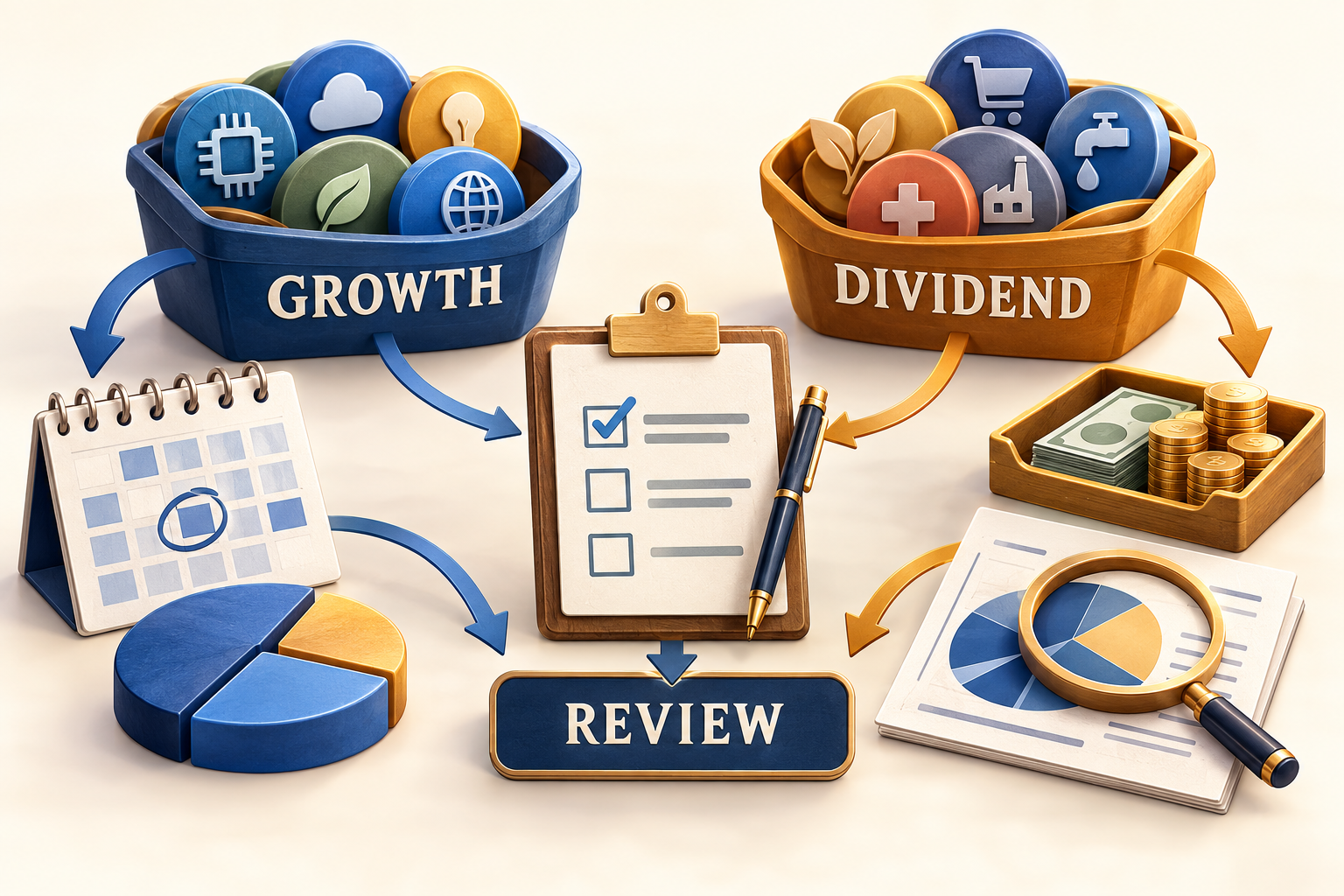
An ETF investor can spend weeks choosing a fund and almost no time deciding how to manage it afterward. The purchase has a rationale; the subsequent trades have a mood. A growth fund falls, so the investor adds because it is “on sale.” A dividend fund lags the S&P 500, so the investor replaces it. Another fund raises its payout, and the investor treats the increase as proof that the investment is improving.
Each response might be defensible. None is defensible from that observation alone. The missing element is a connection between the fund’s strategy, the investor’s objective, and the evidence that would justify a change.
Our opening column, 5 ETF Investing Myths That Can Cost You Money, challenged the idea that one management rule fits every ETF. This article turns that principle into a working discipline: define the holding’s job, judge it on the right evidence, and distinguish portfolio maintenance from a change of investment thesis.
1. A strategy is not the same as a goal
“Growth” is an ambiguous word. Every investor accumulating wealth wants growth, but a growth-style equity ETF is a particular exposure—not a synonym for a sensible long-term portfolio. A broad-market fund can support capital accumulation without being a pure growth-style fund. Dividend-paying companies can also grow their businesses and share prices. These categories are not opposing laws of finance.
For management purposes, distinguish the fund’s selection rules from the job you assign it. A growth-style allocation may deliberately emphasize companies priced for business expansion. A dividend-equity allocation may emphasize dividend-paying businesses and a particular quality or value tilt. The portfolio objective might be accumulation, spending support, or a combination of the two.
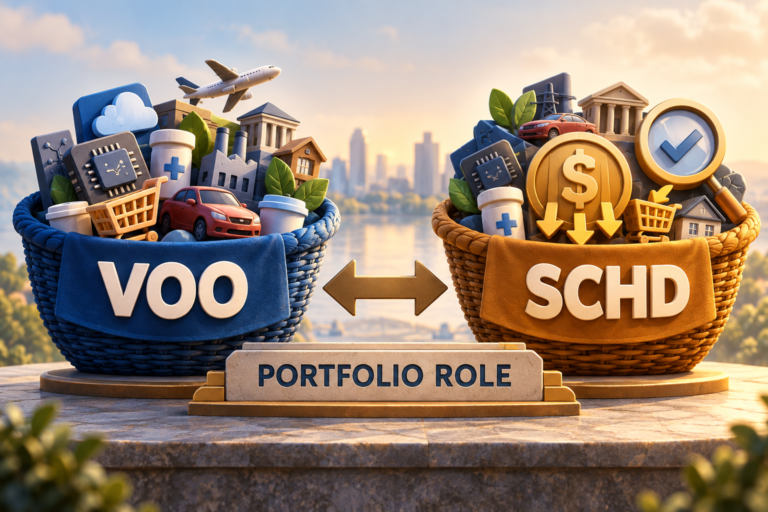
A label therefore starts the investigation; it does not finish it. Read the current objective, benchmark, holdings, and prospectus. For example, Schwab describes SCHD as tracking the total return of the Dow Jones U.S. Dividend 100 Index, with an emphasis on dividend quality and sustainability. That is not a promise of a fixed payment or protection from stock-market losses.
Nor should every fund with a large distribution be placed in the same category. A strategy that sells options to generate income has a different economic engine from a portfolio that simply owns dividend-paying stocks. Before comparing payouts, establish where the cash comes from and what exposure the strategy gives up or retains.
2. Give the holding a written job
A useful mandate is short enough to reread before a trade and specific enough to prevent retrospective storytelling. It should identify the exposure, its intended contribution, its allocation boundary, and the evidence that would trigger a review.
For a growth allocation, an illustrative mandate might read: “This holding supplies a deliberate growth-style tilt within my equity portfolio. I will review concentration, implementation, and allocation drift. I will not add solely because its price has fallen, or replace it solely because another style has recently led.”
For dividend equity: “This holding supplies equity exposure with a dividend-oriented selection discipline. Its distributions contribute to my cash-flow plan, but I will also evaluate total return, purchasing power, and capital risk. A higher quoted yield is not, by itself, evidence of improvement.”
These are examples of decision language, not recommended allocations. A retiree relying on portfolio withdrawals and an investor adding money to a brokerage account each month have different constraints. A fund can be competently managed yet unsuitable for one of those jobs.
3. Review the right evidence—and the whole return
Growth exposure deserves scrutiny of what is driving its risk: the size of its largest positions, sector concentrations, valuation sensitivity, and the way its rules define growth. Strong recent returns can make an allocation larger and more concentrated precisely when the investor feels most comfortable adding to it. Weak returns may reflect a difficult environment for that style rather than a failure to execute the strategy.
Dividend equity deserves an additional cash-flow dashboard. Examine distributions per share across comparable periods, the selection discipline behind the holdings, and whether the resulting cash contribution remains useful. One quarter is a noisy basis for judgment. A higher yield caused by a falling price is not the same thing as an increase in the dollars distributed per share.
Both dashboards must still include total return and portfolio risk. Income is a use of investment value, not an exemption from evaluating it. The following deliberately simplified example shows why.
Both investments start at $10,000 and distribute $400. Case A ends with an investment worth $9,600, plus the cash: total wealth is $10,000 and the simple period return is 0%. Case B ends with $8,600 plus the same cash: total wealth is $9,000 and the return is −10%. An income-only scorecard would miss the difference.
This is not a model of how an actual ETF will behave, and it is not a reinvested total-return calculation. It isolates a basic accounting point: count the remaining investment and the cash received together. If cash is spent, it still belongs in the investment’s return calculation; spending it does not make the payment disappear. Outside deposits and withdrawals require a more careful return measure.
4. Add to a plan, not to a price decline
A lower price does not automatically make a growth ETF a better purchase. The exposure may already be overrepresented elsewhere, or the investor’s capacity to absorb losses may have changed. Adding should follow from the target role, available capital, and current portfolio—not from the distance below a purchase price.
The same discipline applies to dividend equity. Buying additional shares raises the number of shares participating in future distributions, but it also increases exposure to the fund’s holdings and strategy. The desired cash flow should not obscure the amount of equity risk being accepted to pursue it.
New contributions and distributions can be useful tools. Instead of automatically buying more of a holding that has become oversized, an investor can direct available cash toward an underweight allocation. Investor.gov’s rebalancing guidance discusses both sales and additional investment as ways of restoring an intended mix. The important decision is the mix; the transaction is only the implementation.
5. Decide where the cash should go
Automatic dividend reinvestment is convenient, particularly during accumulation. It is not obligatory, and turning it off does not necessarily mean abandoning long-term investing. Cash may be directed to an underweight holding, reserved for planned spending, or reinvested in the same fund when that remains consistent with the plan.
Separate this portfolio choice from its tax treatment. In a U.S. taxable account, reinvesting taxable dividends generally does not eliminate the obligation to report that income. The IRS explains the reporting of reinvested dividends. Account type and individual circumstances matter; reinvestment should not be mistaken for a tax shelter.
For someone using dividends to support spending, ask a more demanding question than “Did the payment arrive?” Consider whether a lower payment would require selling shares, whether the spending plan tolerates that outcome, and whether near-term obligations are being placed at the mercy of equity markets. A dividend ETF remains an equity investment, not a bank deposit.
6. Resize, replace, or exit for different reasons
Rebalancing changes the size of an exposure while retaining its job. Replacement keeps the job but changes the vehicle. Exit removes a job because it no longer belongs in the plan. These are three different decisions; treating them as interchangeable encourages unnecessary trading.
A growth allocation that has become too large might warrant resizing even if the fund is excellent. A dividend fund whose methodology has changed might warrant comparison with alternatives even if its recent return is strong. A holding needed for an objective that no longer exists might warrant an exit even if nothing is wrong with the ETF.
Conversely, a period of underperformance is a question to investigate, not an automatic sell instruction. Compare like with like: strategy, benchmark, measurement period, and treatment of distributions. Underperformance caused by a chosen style is different from persistent implementation problems relative to the fund’s own benchmark.
1 Define the job
What exposure or cash-flow purpose does the holding serve?
2 Check the evidence
Has the strategy, allocation, or investor’s need changed?
3 Choose the response
Hold, add, rebalance, replace, or exit for a stated reason.
4 Check implementation
Consider trading costs and account-specific taxes before acting.
An editorial review framework—not a mechanical trading signal.
Before replacing a fund, write down what the replacement improves and what it changes. A superficially similar fund may introduce a different concentration, selection rule, or trading cost. In a taxable account, selling can also realize gains or losses. A small fee advantage may be outweighed by an immediate tax cost. Use current fund documents and the account’s tax information rather than assuming that a switch is frictionless.
The bottom line: explain the trade first
A helpful review ends with a sentence that connects evidence to action: “I am directing this month’s contribution elsewhere because this allocation is above its intended size,” or “I am reviewing a replacement because the revised selection rules no longer supply the exposure I chose.”
“It has fallen,” “the payout is attractive,” and “another fund is winning” are observations. They are not complete investment arguments. Growth and dividend ETFs should be managed differently where their purposes and economic exposures differ—and consistently where the same requirements apply: total-return accounting, portfolio risk, cost awareness, and a written reason for change.
The real advantage of a management framework is not that it makes every decision correct. It makes decisions reviewable. Years later, the investor can distinguish an intentional allocation from a reaction that merely acquired a convincing explanation after the fact.
Sources and methodology
- Schwab Asset Management: SCHD objective and fund information.
- SEC Investor.gov: Asset Allocation and Diversification.
- SEC Investor.gov: Updated Investor Bulletin—ETFs, for prospectuses, trading, and cost considerations.
- IRS: Reporting reinvested dividends.
Sources reviewed October 5, 2026. The management framework is editorial analysis, not an issuer’s recommendation. The visual examples above are original and hypothetical; they do not represent historical or projected fund performance.
Educational information, not personalized investment or tax advice. Equity ETFs can lose value; distributions and future returns are not guaranteed. This article was not commissioned by a fund provider.
One Comment