
What Is an ETF? Understand the Fund Before You Buy
An exchange-traded fund (ETF) pools investors’ money in a portfolio and issues shares that investors can generally buy and sell on an exchange during the trading day. Buying an ETF share gives you an interest in the fund—not direct ownership of each security it holds. The investment risk depends on the assets and strategy inside.
By Jyoung Ahn · Editorial update October 6, 2026
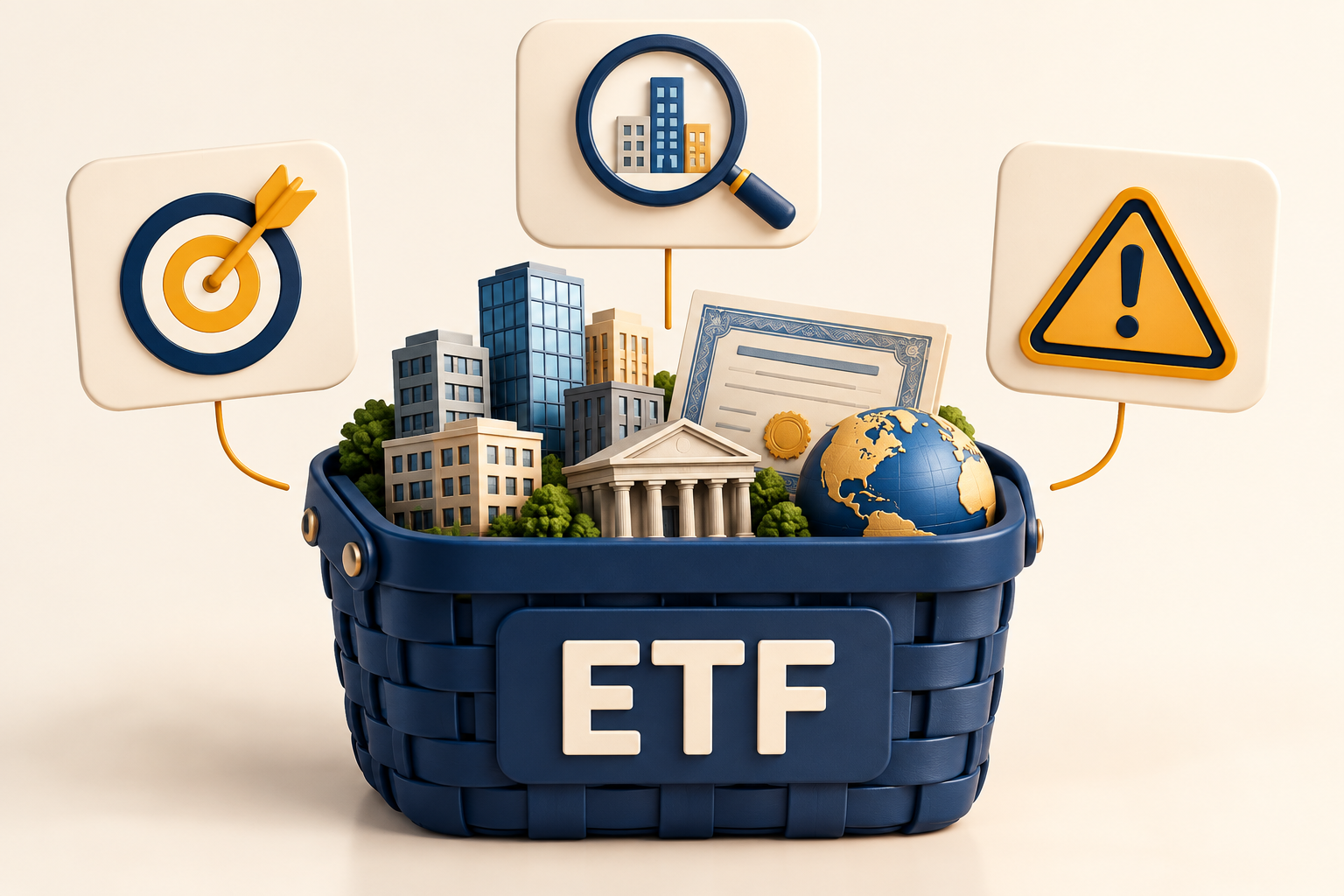
An exchange-traded fund can make investing look remarkably simple. A brokerage screen presents a ticker, a price, and a Buy button. Behind that tidy interface sits a much harder question: what, exactly, will this holding do for the person who buys it?
That question matters to a first-time investor and to someone who has held funds for years. Familiarity with an ETF’s name is not the same as familiarity with its risk. A portfolio can be easy to purchase and difficult to explain.
The useful starting point is to separate the container from its contents. An ETF is a way to own and trade an investment strategy. It is not, by itself, a strategy for allocating your savings, managing withdrawals, or deciding when to change course.
The ETF wrapper is not the investment thesis
An ETF pools investor money and gives shareholders an interest in a portfolio. Traditional ETFs may follow an index or be actively managed; their shares trade on an exchange. The underlying holdings and the fund’s mandate are what give the investment its economic character. SEC: ETF basics
Consider two hypothetical investors. One is building an equity allocation for retirement decades away. The other plans to spend the money on a home purchase next year. The same ticker can be mechanically available to both, yet serve neither equally well. Accessibility does not make a fund appropriate for every time horizon.
An investor’s first sentence should therefore describe a job, not a product: “This money is intended to participate in long-term business growth,” or “This money must remain available for a near-term obligation.” Product research follows that decision. Reversing the order lets an appealing fund advertisement choose the purpose of the money.
The same discipline applies to experienced investors. A new ETF should solve a portfolio problem that can be named before the purchase. If its only job is to have performed well recently, the investment brief is incomplete.
1 · Purpose
Name the job this fund will perform. A long-term equity allocation and money needed soon are different problems.
2 · Exposure
Look inside: assets, geography, company weights, and the rules used to select them.
3 · Maintenance
Decide what you will monitor and what would justify adding, rebalancing, replacing, or selling.
One share connects you to a portfolio
- You, the investor: buy a share through a brokerage account.
- The ETF share: represents an interest in the fund. Its exchange price can differ from its per-share net asset value.
- The fund’s portfolio: holds assets or uses instruments under its stated strategy. A stock ETF and a bond ETF can share the same wrapper while taking very different risks.
Unlike ETF shares, traditional open-end mutual fund shares are generally bought or redeemed at the next calculated NAV rather than traded continuously on an exchange. Neither structure makes a weak strategy a strong investment.
Simplified ownership diagram; not a description of every exchange-traded product. See the SEC’s ETF guide for trading and fund structure.
Look through the ticker to the assets and the rules
A fund name is an introduction, not a complete description. Examine the asset class, geographic scope, selection rules, weighting method, and major holdings. A broad equity fund, a narrow sector fund, and a bond fund do not become interchangeable because all three have ETF in their label. FINRA also distinguishes registered funds from other exchange-traded products with different structures and risks. FINRA: ETFs and other ETPs
A holdings list answers what is owned today. The mandate helps explain what may be owned tomorrow. Both are necessary. A snapshot without the rules can create false comfort; a marketing description without the holdings can conceal concentration.
Ask whether the strategy is understandable without a performance chart. Can you explain what causes the fund to include, exclude, or resize an investment? If not, another period of strong returns will not fill the knowledge gap.
This need not become an exercise in predicting every company. It is a question of identifying the risks you deliberately accept. A broad equity holding can spread company-specific exposure and still leave you vulnerable to a market decline. Diversification is not a promise that the account balance cannot fall. SEC: Asset allocation and diversification
The practical test is how the fund changes your existing portfolio. A second ETF can be useful when it supplies a genuinely different exposure. It can also add another name to essentially the same economic bet. Our ETF overlap framework examines that distinction in detail.
Two prices matter: the trading price and the portfolio value
Retail investors generally buy ETF shares through market transactions rather than purchasing individual shares directly from the fund. The price on the exchange can differ from the fund’s net asset value. Authorized participants create or redeem large blocks of shares, and arbitrage can help align prices with portfolio value; it does not guarantee identical prices at every moment. SEC: How ETFs trade
For the ordinary investor, the important consequence is modest but concrete: the convenience of trading carries an execution decision. A displayed last trade is not a guaranteed purchase price. The price someone is willing to pay and the price someone is willing to accept can differ.
Before an order, look at the quote and the fund’s published trading information. If the structure or pricing behavior seems unfamiliar, resolve that uncertainty before sending the order. Clicking quickly is not a substitute for understanding the instrument.
Intraday access is a feature, not an instruction to act throughout the day. A long-term investment plan can make use of an exchange-traded fund without turning every price movement into a management event.
NAV is a dated valuation, not a guaranteed trade price. A fund calculates its official NAV at least daily, generally at the end of the trading day. Intraday estimates or quotes do not turn that official value into the price you are certain to receive.
Costs belong in the decision—but they do not make it for you
Operating expenses are paid from fund assets, while investors may also encounter trading costs and brokerage charges. A commission-free trade does not eliminate the fund’s expenses or the bid-ask spread. Fees reduce what remains for the investor. SEC: Fund fees and trading differences
The lowest expense ratio is not a sufficient selection rule. A cheap fund that delivers the wrong exposure remains the wrong investment. Cost comparison becomes more informative after the candidate funds are shown to perform a comparable job.
For a hypothetical $20,000 balance held unchanged for one year, an expense ratio of 0.10% corresponds to about $20 in annual operating expenses: $20,000 × 0.001. Actual expenses depend on changing asset values and the fund’s accounting; this is a scale illustration, not an invoice, a current product quote, or a return forecast.
That example helps distinguish a measurable expense from the much larger question of suitability. Saving a few dollars cannot compensate for assigning near-term spending money to a risk you cannot tolerate. Nor does paying a higher fee prove that a strategy adds value.
Match the holding to the account and the way you use cash
The ETF wrapper does not make taxes disappear. A taxable brokerage account and a retirement account are different settings; fund distributions, sales, and account rules can affect the result. The SEC notes that ETFs’ relative tax efficiency is a taxable-account comparison, not the same advantage within tax-advantaged accounts. SEC: Account context
The editorial question is not “Which account always wins?” It is “Which constraints apply to this money?” Withdrawal needs, investment choices, transaction procedures, and applicable tax rules belong in the plan. Individual tax decisions may warrant qualified advice.
Cash-flow preferences also need careful wording. A growth-oriented holding may be evaluated primarily for its contribution to long-term appreciation and overall portfolio risk. A dividend strategy may require additional attention to the sources and durability of distributions. Both still need total-return and risk review.
Do not let a cash payment substitute for an explanation of where it came from. Likewise, do not let the absence of a large distribution convince you that a fund has failed its intended role. The right comparison follows the job assigned to the holding, as discussed in managing growth and dividend ETFs after purchase.
Simplicity is valuable; complexity must earn its place
Not every product sold through an exchange is a conventional diversified fund. Some strategies use leverage, inverse exposure, derivatives, or other specialized mechanisms. Many leveraged and inverse ETFs target daily results, so longer-period outcomes can differ materially from the daily multiple investors expect. SEC: Leveraged and inverse ETFs
Complexity is not automatically a defect. It is an obligation to understand more. For a core long-term holding, a strategy that requires constant explanation, special monitoring, or assumptions you cannot test deserves a higher burden of proof.
The beginner’s advantage is not choosing the most elaborate product. It is avoiding commitments that outrun the ability to evaluate them. The experienced investor’s advantage should be the same: a clearer reason for using complexity, not immunity from its risks.
Write the management rule before the purchase
Research should end with a short operating brief, not just a shortlist of tickers. Describe the role, the risk, the fit with current holdings, and the event that would lead to a review.
Those lines are not automatic buy or sell signals. They provide a record against which later decisions can be tested. A falling price may call for patience, a portfolio rebalance, or a fresh examination of the original thesis. The correct response cannot be inferred from the red number alone.
An ETF is most useful when its convenience supports a deliberate plan. You do not need to know every answer in finance before buying one. You do need to understand enough to explain why it belongs, what could go wrong, and how you will judge it after the purchase.
Once the fund’s role is clear, move to our first ETF purchase guide to review the order, available funds, and confirmation—not to skip this research.
Sources and editorial notes
Official sources are linked beside the relevant claims. Reviewed October 6, 2026. The expense illustration is hypothetical; no historical return, live quote, or future market scenario is presented. Portfolio questions and the five-line worksheet are InvestingAIDesk editorial analysis, not rules issued by the cited institutions.
Educational information, not personalized investment, legal, or tax advice. Investing involves loss risk. Diversification does not guarantee profit or prevent losses. No fund in this article is recommended for a particular reader.